

Trichoscopy with Canfield HairMetrix®

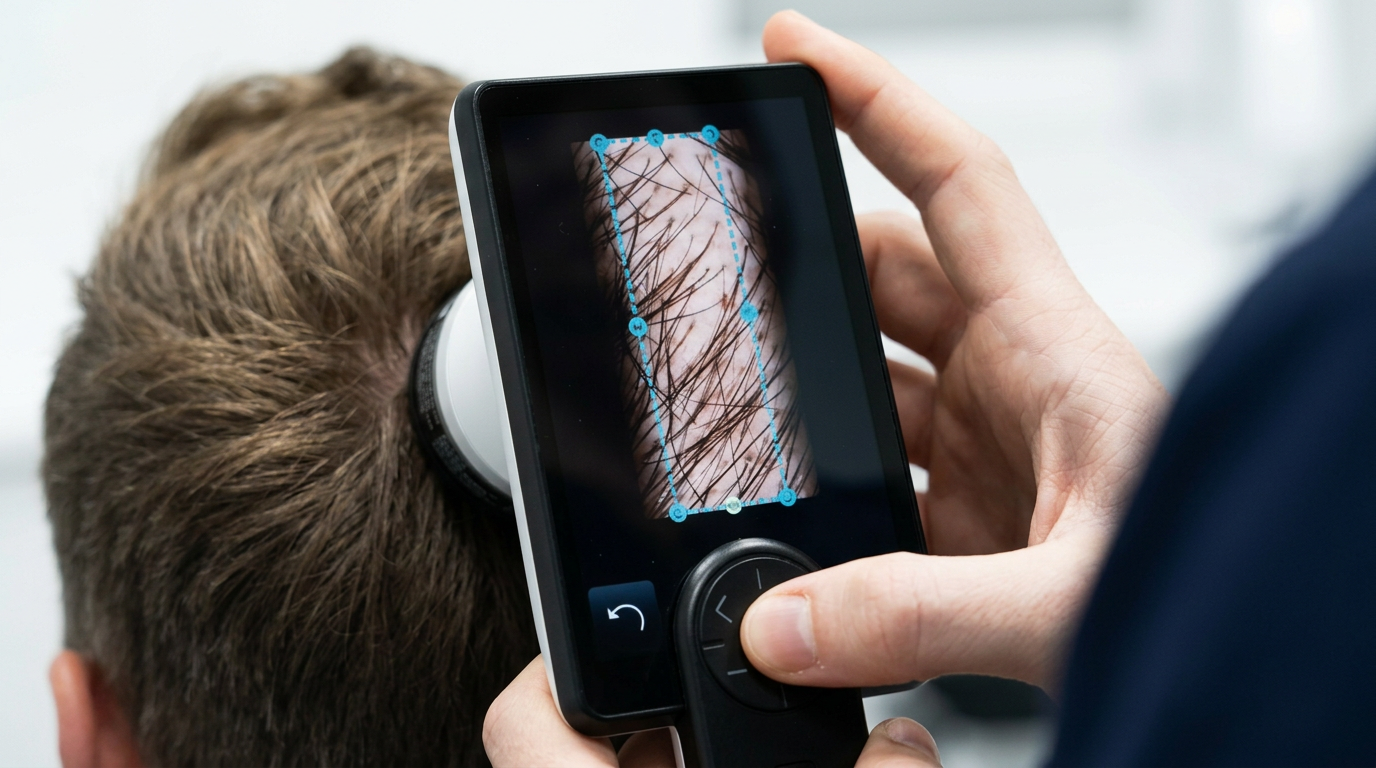
Trichoscopy is an examination of the scalp and hair using a digital dermatoscope at a magnification of 15 to 200 times. The doctor can see hair follicles, hair shaft thickness, skin redness, and dandruff—things that are invisible to the naked eye. The HairMetrix® program counts the hairs in a selected area and measures their thickness, providing a baseline for comparison after three months. No hairs are pulled out or cut.

The examination is ideal if:

  • if you’ve been experiencing excessive hair loss for more than 3 months
  • if your hair is thinning or your part is widening
  • if your scalp is itchy, flaky, or red
  • if you’ve started treatment and want to see if it’s working
  • if hair loss runs in your family

Hair Count with HairMetrix + Consultation with a Dermatologist

We will contact you shortly to clarify the procedure and time of your visit.

+37124401084

Starting at

€ 120,00

In Brief

A Brief Overview of Trichoscopy

Before the visit

Before the visit

  • Before the visitDo not wash your hair on the day of the examination—the doctor needs to see what your scalp looks like on a normal day, including the amount of oil and dandruff.
  • Before the visitDo not use hairspray, mousse, gel, or dry shampoo.
  • Before the visitDo not dye your hair for 2 weeks before the examination.
  • Before the visitIf you use any hair loss treatments, bring them with you or write down their names.
  • Before the visitIf you’ve had blood tests in the last 6 months, bring them with you.
  • Before the visitPlease let us know if your scalp is damaged in any way, if there are wounds or inflammation, or if you are allergic to aluminum or glass—the dermatoscope will not be used on these areas.
  • Before the visitPregnancy and breastfeeding do not limit the examination—it is simply an imaging procedure, with no radiation and no medication.
What happens during the procedure

What happens during the procedure

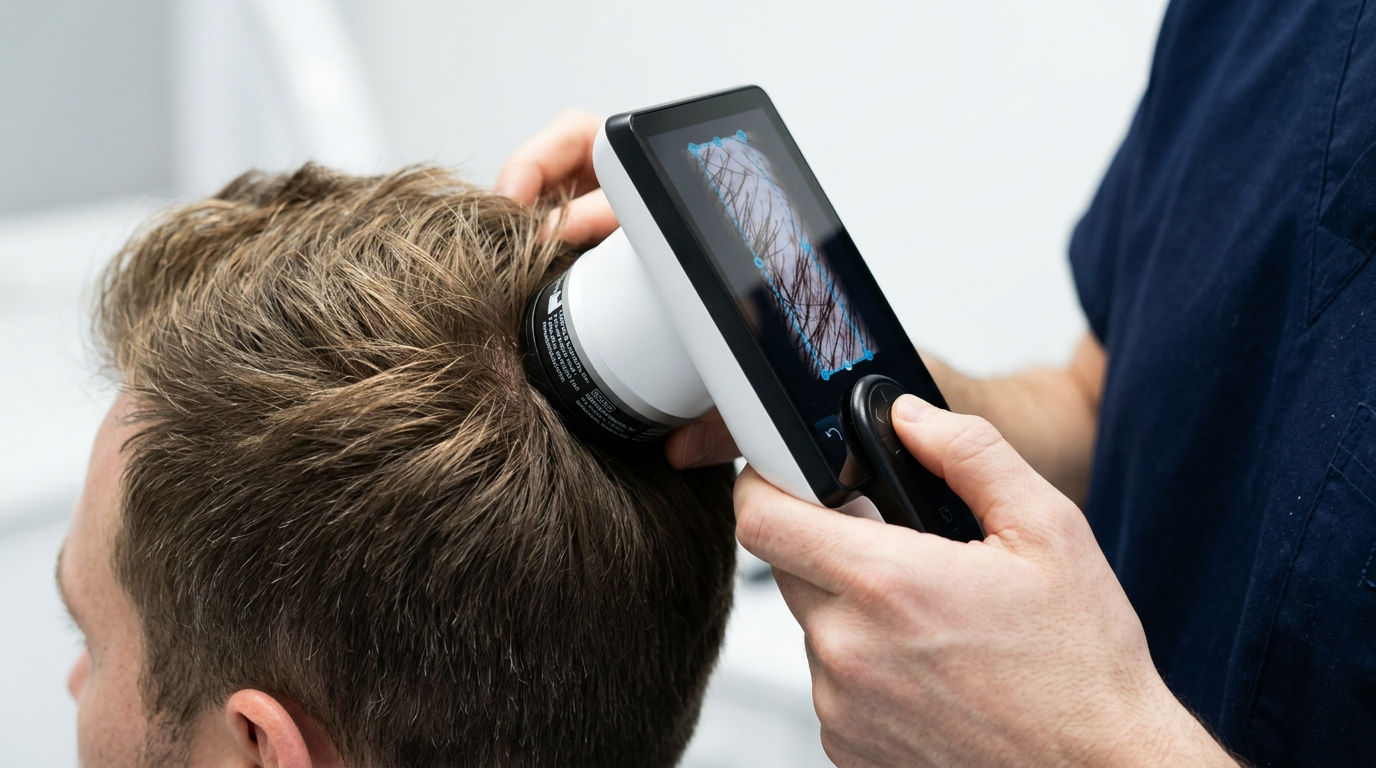
  • What happens during the procedureYou are sitting in a chair; the doctor parts your hair and places the dermatoscope against your scalp.
  • What happens during the procedureAn enlarged image immediately appears on the screen—showing the hair follicles, hair shafts, and the skin around them.
  • What happens during the procedureThe doctor examines several areas: the forehead, the back of the head, the temples, and the area that concerns you, and compares them with one another.
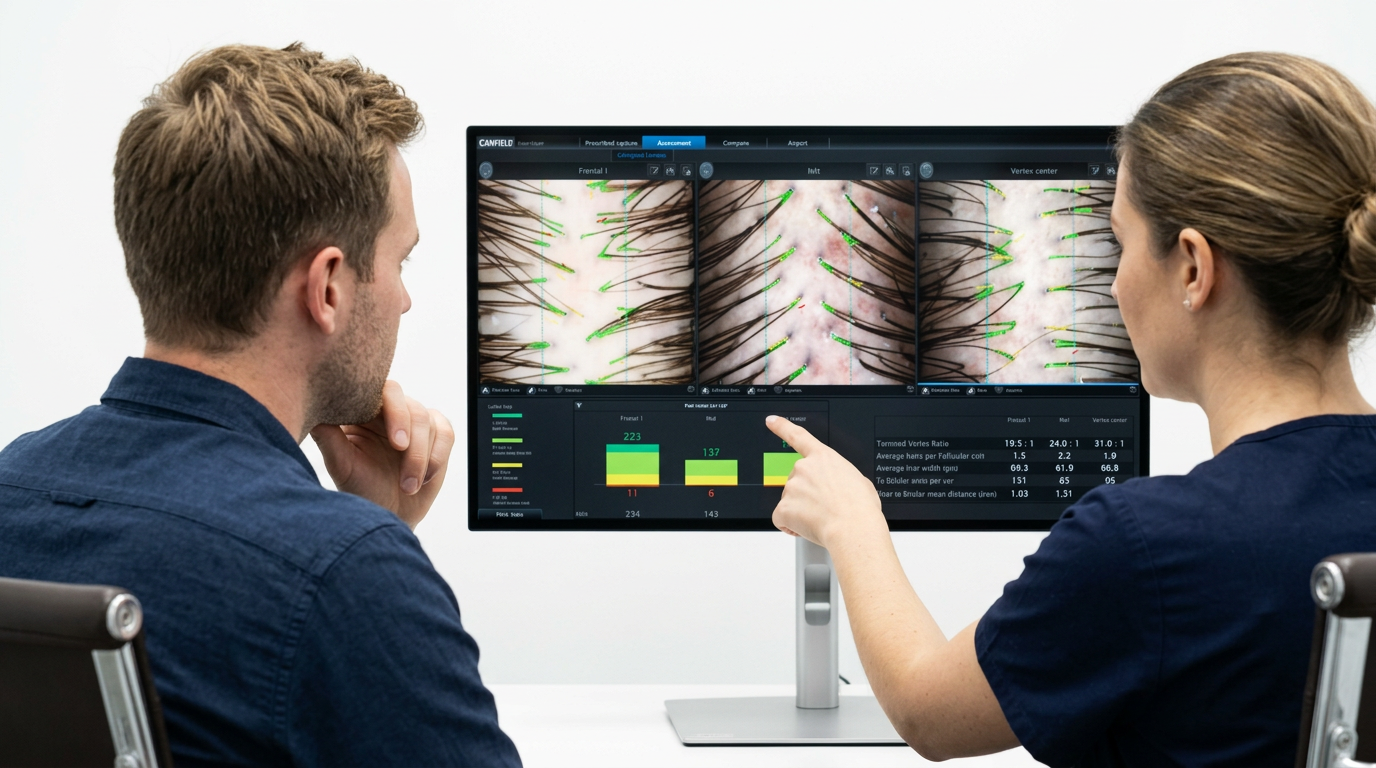
  • What happens during the procedureIn each selected area, the program counts the hairs and measures their thickness.
  • What happens during the procedureNo hair is pulled or cut. The dermatoscope only lightly touches the skin.
  • What happens during the procedureTrichoscopy alone takes about 20 minutes. With a consultation with a dermatologist, the entire process takes about 40 minutes.
Results

Results

  • ResultsYou receive images of each area examined, along with statistics: how many hairs there are per square centimeter, how thick they are, and what percentage are fine, downy hairs.
  • ResultsThis is the condition of your hair on that specific day—recorded, not just remembered.
  • ResultsIf you choose the option with a dermatologist, you’ll also receive a report: what type of hair loss you have, whether tests are needed, what steps to take, and when to come in for a follow-up.
  • ResultsThe diagnosis is made by a doctor, not the program. The numbers help the doctor see what the naked eye misses and check over time whether the treatment is working. The result is individual.
Frequency

Frequency

  • FrequencyThe initial examination serves as a baseline.

  • FrequencyHair grows slowly—about 1 cm per month—so the effects of treatment become visible no sooner than after 3 months, and are clearly evident after 6 months.
  • FrequencyIf you begin treatment, follow-up trichoscopy is usually performed after 3 and 6 months, and then once a year.
  • FrequencyIf the examination was merely a checkup and the doctor found nothing of concern, a repeat examination is necessary only if something changes.
  • FrequencyIf hair loss suddenly worsens or a bald spot appears, don’t wait for your scheduled appointment—make an appointment sooner.
1 /

How does Canfield HairMetrix® work?

During a routine examination, the doctor notices that the hair is thinner. With trichoscopy, the doctor can see why: whether there are fewer hair follicles, or if there are just as many but the hair has become thinner, or if there is inflammation around them. It’s the same Canfield D2 dermatoscope that Linove uses to examine moles—here, it’s equipped with a hair attachment and software that counts the hairs.

D2 Digital Dermoscope

A handheld camera that magnifies the skin 15 to 200 times and displays the image immediately on a screen. The doctor can see hair follicles, hair shaft thickness, blood vessels in the skin, and skin scales—things that cannot be seen with the naked eye or a magnifying glass.

Three Types of Light

Each area can be examined under white light, filtered light—which eliminates surface glare and reveals blood vessels and pigment—and ultraviolet light, which helps identify fungal infections and certain types of inflammation.

HairMetrix®—a program that counts

In the selected area, the program automatically detects each hair and measures it. The doctor receives the number of hairs per square centimeter, the average hair thickness, the ratio of thick to vellus hair, and the number of hairs in a single follicular unit. The hair is neither cut nor shaved. The next time, the same area is compared to the previous one.

Advantages

  • Numbers, not impressions: hair density and thickness are measured, so after three months, changes can be seen, not just guessed.
  • Non-invasive: no need to pluck hairs for a sample, no need to shave an area, no biopsies—in most cases.
  • One device for two purposes: the same medical-grade dermatoscope used in clinics to examine moles.
  • Comparability over time: images and measurements remain on your map, and each subsequent entry is placed next to the previous one.

15x to 200x magnification, three light modes, seven measurable parameters in each area—and after three months, the same area is measured again to see if the treatment is working.

When is this test recommended?

Who is this test suitable for?

Hair loss

Excessive hair loss lasting longer than 3 months

Hair is becoming thinner and sparser

The part is widening or the hairline is receding

Round, hairless patches

Hair loss after childbirth, illness, or surgery

A family history of hair loss

Scalp

Itching

Dandruff and flaking

Redness

Oily or excessively dry scalp

Pain or burning sensation

Treatment monitoring

Before starting treatment — baseline

During treatment—is it working?

Before and after a course of PRP or mesotherapy

Before deciding on a hair transplant

Specialists

Specialists who perform trichoscopy

BUJ

Frequently Asked Questions

Does it hurt?

The dermatoscope only lightly touches the skin. It does not pull or cut the hair, and there are no injections or anesthesia.

Will I have to cut or shave my hair?

No. HairMetrix® counts uncut hair—the doctor simply parts the hair and places the dermatoscope against the skin.

How long does it take?

Trichoscopy alone — about 20 minutes. Including a consultation with a dermatologist — about 40 minutes.

Can I wash my hair before the exam?

It's better not to do this on the day of the examination. A clean scalp hides what the doctor needs to see—the amount of oil and dandruff.

How soon will you be able to tell if the treatment is working?

No sooner than 3 months later. Hair grows about 1 cm per month, so the first follow-up appointment is usually scheduled for 3 months later.

Will I know the cause right after the examination?

Often, yes. In some cases, the doctor will also order blood tests—for example, to check iron, thyroid, or vitamin D levels.

Can this be done during pregnancy?

Yes. It's just an image—no radiation, no medication, and no skin penetration.

Who should not undergo this test?

Do not use the dermatoscope on damaged skin, wounds, or areas where an infection is suspected.