
Izpārdošana!

Body Composition Analysis with the InBody 770S

A body composition analysis breaks down your weight into its components: muscle, fat, water, and minerals. You stand on the machine and hold the handles; a weak alternating current flows through your body, and the machine measures the electrical resistance in each part of your body separately. You leave with a results sheet and an explanation—you see not only how much you weigh, but also what that weight consists of and how it’s changing.

This examination is ideal for:

  • If your weight stays the same and you want to know whether your body is changing anyway
  • if you want to lose weight but don't want to lose muscle
  • If you're getting ready for a fitness program or a training course and need a starting point
  • if the body mass index isn't a good indicator in your case—for example, if you exercise regularly
  • if a doctor wants to assess fluid distribution or muscle mass

Book now

We will contact you shortly to clarify the procedure and time of your visit.

+37124401084

Starting at

 30,00

Buy online

Get a discount when purchasing 2 or more sessions.

Starting at

 30,00

 40,00
€30.00 €40.00

Amount

At a glance

A Brief Overview of Body Composition Analysis

Before the visit

Before the visit

  • Before the visitDo not exercise 6–12 hours beforehand, and do not eat 3–4 hours beforehand.
  • Before the visitDo not consume coffee or alcohol for 24 hours beforehand.
  • Before the visitDo not take a sauna or shower immediately before the measurement, and do not apply lotion to your hands and feet.
  • Before the visitThe day before, drink water as usual.
  • Before the visitPlease come without jewelry or a watch.
  • Before the visitBefore taking a measurement, consult your doctor if you have a pacemaker or other life-sustaining implant, if you are pregnant, or if you are menstruating.

What happens during the procedure

What happens during the procedure

  • What happens during the procedureTake off your shoes and socks.
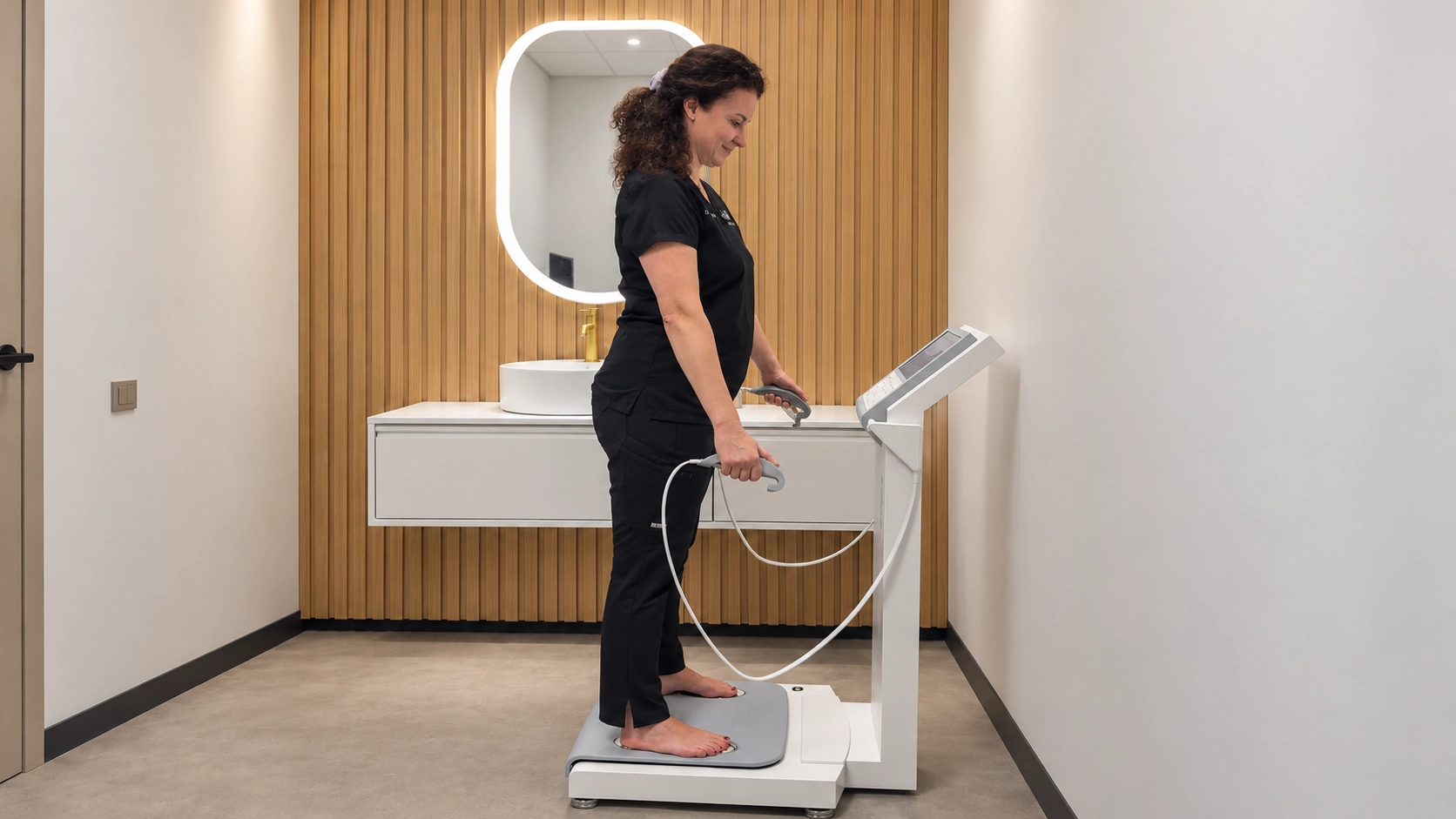
  • What happens during the procedureStep onto the machine's platform barefoot so that your heels are on the round electrodes, and stand still while your weight is measured.
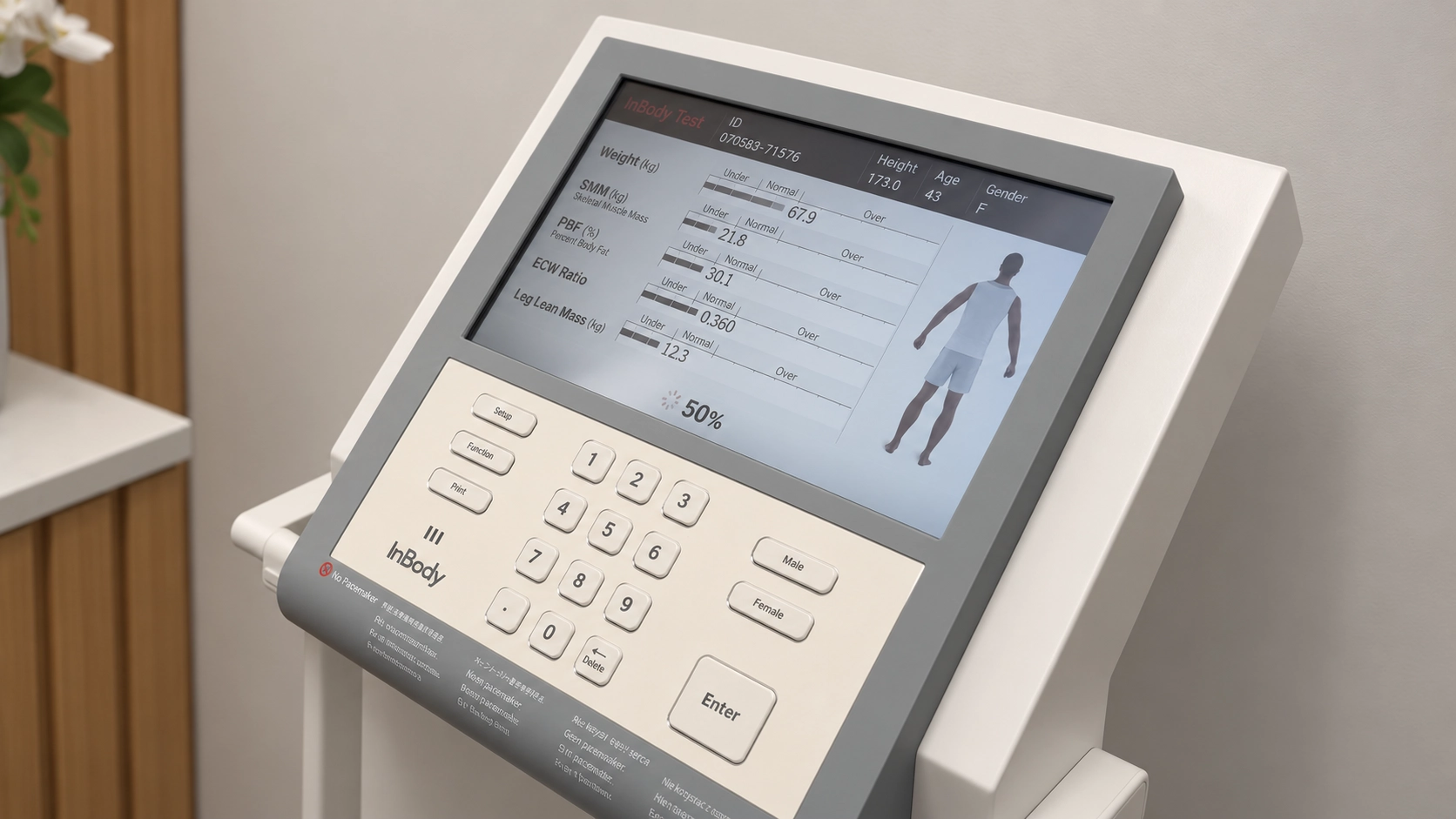
  • What happens during the procedureEnter your age, height, and gender.
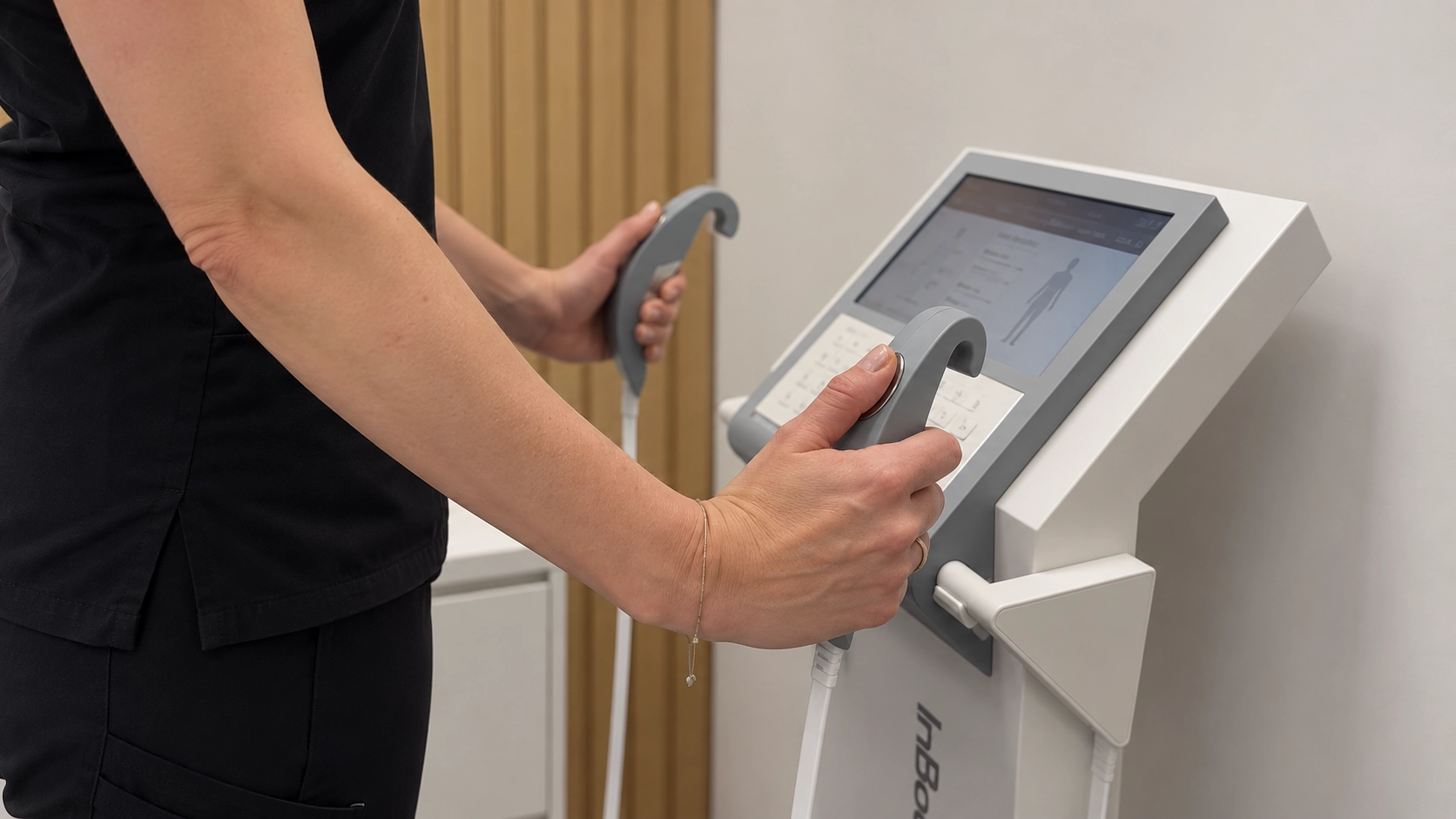
  • What happens during the procedureGrasp the handles—with your thumbs on the upper electrode and the rest of your fingers wrapped around the lower one—and hold your hands slightly away from your body.
  • What happens during the procedureThe device tells you exactly what to do. The measurement takes less than a minute, and the results are printed out immediately.
Results

Results

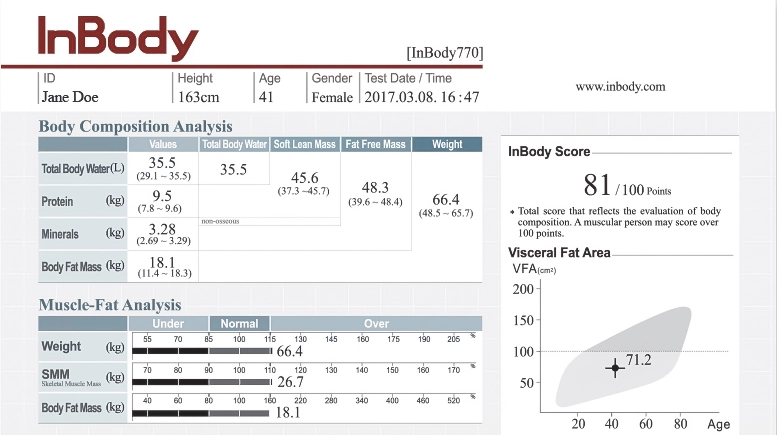
  • ResultsYou will receive a results sheet showing your muscle mass, fat mass and percentage, visceral fat area, body water distribution, basal metabolic rate, and the composition of each body part individually.
  • ResultsHere is an explanation of what each number means and which metrics fall outside the reference values.
  • ResultsThis explanation is not a diagnosis and does not replace a doctor’s opinion. If any of the results require evaluation, please schedule a consultation with a doctor. Results vary from person to person.
Frequency

Frequency

  • FrequencyGetting measured once serves as a baseline. The significance becomes apparent through comparison.

  • FrequencyRepeat the measurement every 2–4 weeks. There’s no point in doing it more often: any difference over a shorter period is most likely due to fluid, not muscle or fat.
  • FrequencyThe device stores the last 10 measurements under a single number and displays them in a single graph on the results page.
  • FrequencyTake measurements under the same conditions—at a similar time of day and with the same preparation.
1 /

How does the InBody 770S work?

It is not possible to weigh body composition—it can only be measured indirectly. A weak alternating current is passed through the body, and the resistance it encounters is measured. Muscles contain a lot of water and conduct electricity well. Fat tissue contains little water and resists the current. Based on this difference, the device calculates the proportion of each component in the body.

Segmental Measurement

The body isn't a single unit. The arms, legs, and torso are measured separately, so the results show not only the total amount of muscle but also how it is distributed—and whether one side lags behind the other.

Multi-frequency measurement

The measurement is performed at several alternating current frequencies. Low frequencies flow around the cells, while high frequencies pass through them. Therefore, the device is able to measure the water inside and outside the cells separately, rather than just their combined total.

ECW/TBW — Water Distribution

The ratio of extracellular water to total body water indicates whether fluid distribution in the body is normal. This indicator is measured for the entire body and for each part separately, so fluid accumulation in just one arm or leg is also visible.

Phase angle

A measure derived from the current shift across cell membranes. A higher phase angle indicates better cellular health. It is measured for the entire body and for each segment, and it provides specific information in the assessment of metabolism.

Benefits

  • Radiation-free: The measurement is performed using a weak alternating current, not X-rays.
  • No skin contact: the electrodes consist of a platform under the feet and handles in the palms.
  • Repeatable: Under the same conditions, the measurement can be repeated every 2–4 weeks, and the results are comparable.
  • Comprehensive, not just weight: a single measurement provides muscle mass, fat mass, visceral fat, body water distribution, basal metabolic rate, and the composition of each body part.

Five body segments, each measured separately at multiple frequencies up to 1,000 kilohertz, more than 20 separate resistance measurements—and all in less than a minute, with no radiation and no needles.

When is an examination necessary?

Who is this test suitable for?

Weight and Metabolism

Svara samazināšana bez muskuļu zuduma

Svars, kas nemainās, lai gan ķermenis mainās

Viscerālie tauki ap iekšējiem orgāniem

Vielmaiņas pamatlīmenis un kaloriju vajadzība

Ķermeņa masas indekss, kas neatbilst patiesajam stāvoklim

Uztura vai treniņu plāna izvērtēšana

Body treatments and workouts

Atskaites punkts pirms procedūru kursa

Muskuļu masas izmaiņas treniņu laikā

Kreisās un labās puses līdzsvars

Roku un kāju sastāva atšķirības

Rezultāta izsekošana kursa laikā

Medical indications

Šķidruma sadalījuma novērtēšana organismā

Lokāla šķidruma uzkrāšanās vienā ķermeņa daļā

Muskuļu masas zudums gados vecākiem cilvēkiem

Olbaltumvielu un uztura pietiekamības novērtēšana

Viscerālo tauku daudzums kā vielmaiņas risks

Šūnu stāvokļa novērtējums pēc fāzes leņķa

Specialists

Specialists who perform InBody 770s measurements

FAQ

Frequently asked questions

Does it hurt?

A weak alternating current flows through your body, which most people do not feel. You stand there holding the handles.

How long does it take?

The measurement itself takes less than a minute. Including preparation, data entry, and printing the results, it takes about 15 minutes.

Will I have to undress?

No. You just need to take off your shoes and socks and remove any jewelry and your watch. You can keep the rest of your clothes on.

How is this different from home scales that measure body fat?

Home scales measure through the feet and calculate the rest. This device measures five body parts separately, at multiple frequencies.

How often should the measurement be repeated?

Changes become noticeable after two to four weeks. There's no point in measuring more often—the difference will be due to fluid, not composition.

Who should not undergo this test?

Before taking a measurement, consult a doctor if you have a pacemaker or other life-sustaining implant, are pregnant, or are menstruating.

Does the doctor explain the results?

You will receive your results sheet along with an explanation. If any of the results require further evaluation, please schedule a separate consultation with a doctor.

Can I eat and drink coffee before the test?

No. Do not eat for 3–4 hours before the test, and do not consume coffee or alcohol for 24 hours before the test—they can affect the results.